Fight
Big Agribusiness Power-Grab in Michigan! Legislation (H.B.
5128/S.B. 654 & H.B. 5127 & S.B. 655) has been introduced in
Michigan which hands enormous power to Big Agribusiness interests,
codifying inhumane industry standards for the treatment of farm
animals. These standards even allow many animals on factory
farms to spend the majority of their lives in cages so small
they can't even turn around or extend their limbs.
Read:
"Judging the Quality of Internet Care Information"
DID YOU KNOW... Rabbits and guinea pigs have an atypical calcium metabolism
that predisposes them to bladder stones, but the same is NOT
true for chinchillas, who are far more likely to suffer from
malocclusion caused by calcium deficiency. Read
more...
If your chin doesn't gnaw chew toys -or- doesn't eat hay -or-
has calcium deficiency (alfalfa
hay is important and beneficial to a chin's diet!), then
he's headed for malocclusion, which can end in a horrible death.
Article
Chinchillas are territorial by nature, if you have more than
one bonded group, you should read
this.
CRITICAL
POINTS OF CHINPARENTHOOD, "BEFORE YOU BUY!"
Also see: article by eRodent
and ChinCare's adoption contract/ qualification assessment (.doc)
and care sheet (.doc)
Chinchillas can be the
ideal companion. Normally gentle and friendly creatures, they only
bite
or spray urine under extreme
duress, even the most vocal
ones don't make noise often, shedding
is very minimal, their fecal droppings
are small, hard and odorless (and continually deposited!) and their urine isn't odorous as long as their
cage
is kept clean. Basic
requirements
include: a LARGE
cage, a chin-proofed
play area, and unlimited access (only ration treats)
to
the dietary staples of fresh, high quality pellets,
hay,
and distilled or filtered water.
There ARE potential drawbacks to having a chin as a pet, however,
so don't make the initial
investment unless you have acknowledged the following and are certain
you can commit to
providing all the attention, time, energy and expense needed for an
entire chinchilla lifetime:
Chinchillas themselves are NOT
"HYPOALLERGENIC" nor is the hay they eat every day and
the ample dust they bathe
in regularly. They are not
recommended for young children or as classroom pets for several
reasons that directly relate to the chin's well-being and the children's
expectations.
Although they appear cute and cuddly, chinchillas in general are not
sedentary lap pets who will sit still and welcome lots of holding
and cuddling. They are usually sociable and enjoy interacting with
people, but they like to be on the move: exploring, energetic, playful.
While some pets will accept being dominated and controlled by their
owner, chins really do not. They prefer to have things on their terms:
they have a keenly intelligent, curious and independent nature with
a mind and will of their own and are best
related to as companions rather than treated as mere pets. Some
chins need to be socialized
and can require a lot of time and patience before they're able to
bond with their chinparent. It takes someone with maturity and intelligence,
emotional as well as psychological, to truly appreciate them.
Chinchillas must be kept indoors in a climate-controlled environment.
AIR
CONDITIONING IS MANDATORY, not optional, for chins in climates
where the temperature can reach 70°F. Heat plus high humidity (above
60%) can easily kill chinchillas, because they have the highest
fur density of any land animal in the world.
Chinchillas think and behave a lot like
small children, and their active, intelligent
minds can easily become stressed or bored (which is a catalyst
for various health and behavioral problems)
if they are forced to sit, caged, for hours on end without sufficient
environmental stimulation, exercise or interaction. Providing this,
especially for a single
chin who relies entirely on the chinparent for companionship, can
be very TIME
CONSUMING because out-of-cage activity requires constant supervision:
chinchillas are rodents and they will gnaw, gouge or shred anything
not sufficiently "chin-proofed."
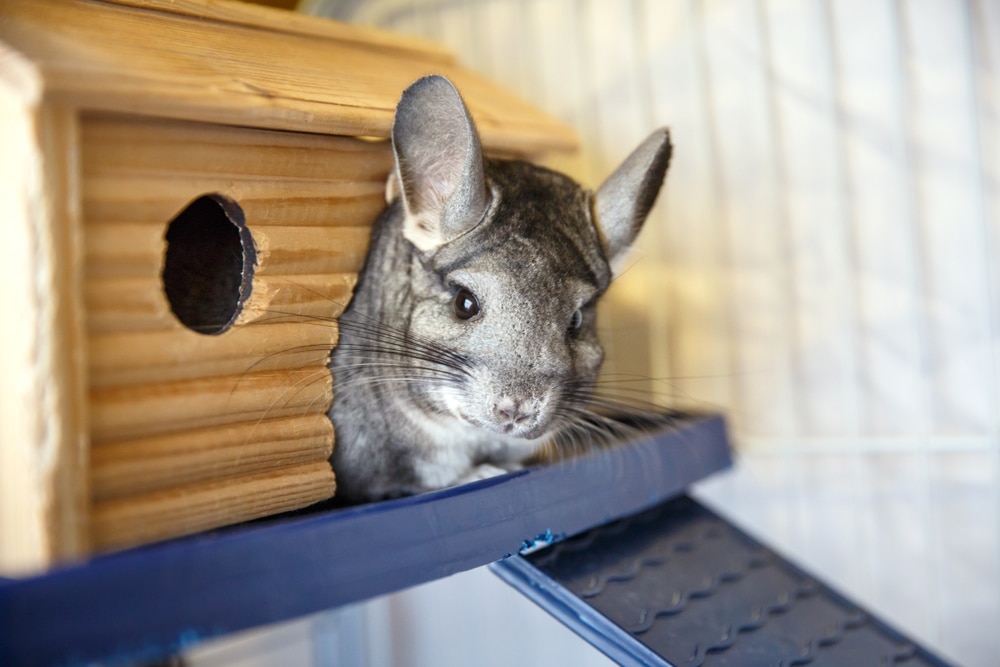
A LARGE
cage to accomodate running and playing, a variety of chew
toys, at least one hideaway
per chin and a cage wheel
will help decrease stress and boredom inside the cage while TV
during waking hours will provide environmental stimulation when the
chin isn't actively engaged in out-of-cage exercise
and interaction.
Chinchillas are VERY
LONG-LIVED! The average chinchilla life expectancy in captivity
is 10-15 years, but with good genetics and good lifetime care they
can live 20+ years. For that entire long term commitment they'll need
knowledgeable, devoted care, regardless of whether their chinparent
experiences a change in lifestyle or preferences: busier schedule,
new hobby/ interest, going off to college, joining the military, relocating,
starting a family, etc.
Pet stores often mis-sex chinchillas!! It's not unheard of for
someone to buy a female that's already pregnant because the pet store
grouped the animals by color/ price range instead of by gender. It's
also not unusual for someone to buy a "same-sex" chin as
company for the one they got from a pet store and end up with a litter
because the pet store employee mistook the female chinchilla's urethral
cone for a male chinchilla's penis. Before you buy, learn how to identify
gender to prevent overpopulation and unwanted pets!
Chinchillas are regarded as an exotic animal. The "startup cost"
for a new chinparent (see Zillah Chinchilla's basic list)
is substantial and VET CARE FOR EXOTICS IS
EXPENSIVE! For example, malocclusion,
a relatively common and potentially lethal dental condition that chinchillas
can suffer from, may be treatable
if detected early by a yearly check-up head x-ray. The vet visit,
with examination and x-ray, can easily cost over a hundred U.S. dollars.
When selecting a chin, health
and temperament should be the foremost consideration, not strictly
appearances. The colorful "mutations"
(every color but the original gray is the result of recessive gene
breeding and/ or inbreeding.
Some colors are more established and stable than others) can be
less hardy, not as long-lived and more erratically temperamented than
the standard gray. Most importantly, every chin deserves "a
good home"!
ORGANIZATIONS
& EVENTS
Note: ECBC
and MCBA are not listed among our pet organizations because
they are the U.S. pelter clubs.
While we respect people's choices, we sincerely hope that someday
the pet breeders who comprise the majority in both clubs will
make progress in getting them to change direction and better
represent the pet interests of their membership.
Since 2002 we
have hand-reviewed nearly all the English language pet chinchilla
care sites (over 700 as of 2008) on the web for the educational
purposes of this site. The following
sites are, in our estimation, the most thoroughly informative (substantial
coverage on nearly all topics) and usually factually reliable
pet chinchilla care sites on the web.
This list is subject to updates. Our Disclaimer
and ChinCare's
Principle applies.
The ChinCare
webmasters regretfully admit that we are linguistically challenged
outside of our
native habitat, so this is not the most comprehensive list, just a
sampling of what we've found:
Non-English
Articles Spanish article-
Centro Veterinario Carlinda, .pdf by
Jaime E. Jiménez, PhD, et al:
Pet Guide Series (.pdf),
in Japanese
"Glorious Past, Threatening Present" (.pdf),
in Italian
Be advised that there are some forums that act more as personality
cults for their leadership, where bullying and misinformation are
rife, and those forums are not on our list. Unlisted status does not
necessarily make a forum one of those to avoid.
The following quote is from
Chinwags.
In our opinion this prudent and responsible approach should be
adopted by all forums:
"Our first port of call if worried should always be the vets.
We should try to remember the difference between our own experiences
(which in themselves can vary in different situations) and
information we have picked up along the way.
"Where possible would you please make clear where any details
you mention came from, have you been through this or have you read
it somewhere? If from a website/message board please provide a link
where possible (or link and quote), so that other members may
make a better judgement for themselves as to the validity of the details.
We ask that you do not try to impose your views on others, just let's
be here to share, comfort and help where we can."